Showing posts with label Liverpool. Show all posts

Thursday, 3 December 2009

The Cavern Wall of Fame


The Cavern Club in Mathew Street, Liverpool, is “Where it all began” – the venue that saw the debut performances of The Beatles and that has seen so many other famous groups and singers on its stage.


As a teenager I only went to the Club once and cannot even recall who was playing that night. Nowadays it is a shrine to the Beatles, as indeed, is the whole Mathew Street area of Liverpool.   Opposite the Cavern Club, next to the Cavern Pub, is a Wall of Fame. It consists of bricks which each have the name of a band that has played the Cavern.


On the wall are such famous names as the Rolling Stones, Gerry and Pacemakers, Freddie and the Dreamers, the Drifters, Manfred Mann, the Hollies, the Searchers, the Animals and so many more.


The wall was created in 1997 to commemorate the 40th anniversary of the opening of the Cavern Club.


Recently the sexual antics of Gary Glitter and Jonathan King – because they involved minors – have resulted in their bricks being removed from the wall and there is a plaque to that effect on the wall.


With typical Scouse humour some wag has put a tiny spot of paint on the plaque as a result of which the word ‘Brick’ has been changed so it now begins with a P. Some would think this was an appropriate thing to happen to those who interfere with minors.

Odds and Real Sods


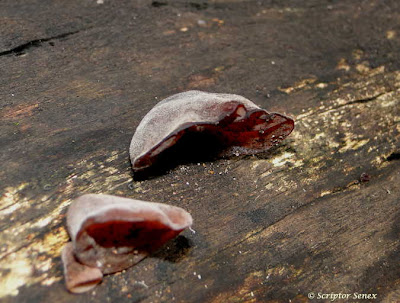
Whilst having a walk around Lower Heswall the other day I came across some Ear Fungus on a log. Auricularia auricula-judae is also commonly known as Judas's Ear fungus or Jew's Ear, the name from which it derives the "judae" in its scientific name, or as the Jelly Ear fungus. It was said that Judas hanged himself on an elder tree and the fungus is usually found on Elder or Ash. The term 'Jew's Meat' was also a deprecatory term used for all fungi in the Middle Ages.


As I get older I like change less and less. It is incredibly minor in the great scheme of things but Amanda Hamilton is leaving ‘Something for the Weekend’ and I am sorry about that. The chemistry between the three of them – Amanda, Simon Rimmer and Tim Lovejoy – makes for a most entertaining Sunday morning show and it will take a new girl a while to build up that rapport. And, as Amanda said, pity the girl who has to sit and listen to the boys talking football all the time!

And yes, the man is complaining about comments again. I have this Chinese commenter whose comments have the same glyphs each time and therefore are obviously not relevant to any particular post. When I clicked on their blog name I was led to an obscene website. So I decided to report them to Google.

The relevant Google page says choose which type of abuse you wish to complain about. So you do that and go to another page. Eventually you get to one which says ‘click on the report abuse tab at the top of the person’s blog’. But the site that clicking on their name leads to is not a blog but a website so you can’t do that. OK, Google says ‘If you cannot do that ‘click here’ for a report abuse form’. You click there and it takes you back to the initial report abuse page which says choose which type of abuse.... (Puts pillow over face so he can scream without waking whole neighbourhood.)

Please don’t get me wrong, I love getting comments and it is worth the effort of rejecting the abusive, obscene and advertising but that doesn’t stop them from driving me up the wall.... So, for the moment, I have re-introduced a CAPTCHA (word verification) stage. I apologise to those who find these a nuisance but I want to see if it discouarges some of the idiots.


Despite having used it in cooking for years it was only today that I found out what Allspice is. I always thought it was a mix of spices like Chinese Five Spice.


Actually the spice comes from the berries of the tree Pimenta dioica. It takes its name from its aroma which smells like a combination of spices, especially cinnamon, cloves, ginger and nutmeg. In much of the world, allspice is called pimento because the Spanish mistook the fruit for black pepper, which the Spanish called pimienta. This is especially confusing since the Spanish had already called chillies pimientos. In the eighteenth century it was called English Spice because of its popularity in this country. For more about Allspice see the useful and interesting Encyclopedia of Spices.

Wednesday, 2 December 2009

The Pier Head


I saw the antiques programme ‘Flog it’ on Monday and was ashamed of myself. It was being broadcast from Liverpool and Paul Martin, the presenter, was showing off the new Museum of Liverpool building to be opened at the Pier Head in 2011. I wasn’t even aware of it. Another huge building was being erected next door to it as well. I realised it was over ten years since I was in the city centre itself and during that time there have been lots of new office blocks, an enormous new shopping precinct and these two buildings. I really know so little about what is going on in the Merseyside area. I am determined to change this and make an effort to get out and about and keep an eye open for interesting events in the future. So on Tuesday, despite a cold wind and thick cloud I headed for Liverpool.


There were, of course, Penguins everywhere but I shall post about them and various other things I saw on another day.    I shall concentrate on the Pier Head today.These two penguins were outside the ferry terminal building and, by jove, it was cold enough for them on Tuesday! 


Above:- The Royal Liver Building


Above:- The Cunard Building


Above:- The Port of Liverpool Building


The new Museum of Liverpool building.  This will house a large collection of items relating to the history of Liverpool over the centuries including such grand items as the steam engine 'Lion', a carriage from the old Overhead Railway; and first Ford Anglia ever to roll off the Halewood assembly line.


Sitting next to the ‘Three Graces’ (the Royal Liver, the Cunard Building and the Dock Board) the Museum is a very modern and striking design. It seems to me to be entirely appropriate to the area and I understand it is the largest purpose built museum in the UK in the last 100 years.


The Leeds Liverpool canal was begun in 1773 and ’finished’ in 1816 but the Liverpool end only went as far as Stanley Dock. Recently it has been extended all the way to the Pier Head. There is a temporary hitch higher up the canal which means there are no canal boats reaching here as yet but it will be really colourful when they do.


In the centre of this picture  is the Mann Island scheme. It is all angular black glass and has three buildings which will contain commercial space,  retail and leisure space, apartments and a car park.


The Port of Liverpool Building (formerly the Mersey Docks and Harbour Board Offices, more commonly known as the 'Dock Board'), a Grade II listed building, reflected here in one of the new eco-friendly Mann Island buildings.

I hope you enjoyed your trip to Liverpool's Pier Head and I shall be happy to give you more conducted tours of the city of my birth another day...


Sunday, 23 November 2008

Radio City Tower

Having received a very pleasant and complimentary e-mail from Neil Prendergast about putting photos of Liverpool on my blog I thought I’d better make the effort and put a few more on. This series is of the tower being built as a part of the St John’s Precinct project in the early 1960s.

The Radio City Tower was completed in 1965. Originally it housed a rotating restaurant, but this soon went out of business. It was then vacant until 1990 when a local radio station, Radio City, took over the tower. It is now open to the public at specified times as an observation platform.

For those who wish to see more of my Liverpool photos there are some hidden away among the postings on my Memories are Made of This Blog.


Thursday, 6 March 2008

More Bollards


When I did a blog on bollards GB commented I would find many in ‘new’ Liverpool compared to my 1960s trips around the side streets. How right he was!


There are bollards everywhere.


Unfortunately I couldn’t find a single old-fashioned one though one of the styles was at least a reproduction of an earlier style. (I could tell they weren’t 1960s ones by the material they were made of and by the .com advert on them!)


Above are a just a few of the styles to be found nowadays.


In Chinatown the bollards are in keeping with the style of some of the other street furniture like lamp posts.

Tuesday, 4 March 2008

Exchange Flags, Liverpool


Exchange Flags was the site from the 1700s of the Liverpool cotton exchange and the insurance and shipping business. These buildings were erected in 1863 and were the third on the site. At one time you had to be invited to walk on the flags which form a square behind the Town Hall.


Since I took this photo in the 1960s the flags have got even quieter and the seats around the edges have disappeared. When Queen Victoria visited Liverpool in 1851 and looked out from the rear balcony of the Town Hall onto Exchange Flags, where the merchants of Liverpool still conducted business in top hats, she remarked that never before had she seen so many well-dressed gentlemen together.


In 1813 this monument to Nelson was erected on the flags as a tribute to a man much admired in a city so dependent on shipping. It was Liverpool’s first public monument.


There are four grills in the monument which provided air vents for a tobacco warehouse underneath the flags. Now they provide a repository for rubbish! Also under the flags was the secret wartime bunker where the North Atlantic operations were masterminded.


The figures around the side of the monument look as though they represent slaves but in fact they symbolised prisoners from Nelson’s four major battles - Cape St Vincent, The Nile, Copenhagen, and Trafalgar.

Sunday, 2 March 2008

Tower Buildings, Liverpool


I took this photo in the 1960s and the main building you can see is Tower Building, Water Street, which was a set of offices built on the site of the original Liverpool Tower, the ancient home of the Stanley family who would later become the Earls of Derby. With its Edwardian facade and towered elevations, it was designed in 1908 by W. Aubrey Thomas, the architect of the Royal Liver Buildings. It is one of the earliest steel-framed buildings in the UK. It is a Grade II listed building and has recently been converted into apartments for sale, rent and hotel hire. The design was to include a ground floor consisting of bars and restaurants but I don’t know if that was done.

Thursday, 28 February 2008

India Buildings, Liverpool


Although the external architecture of Liverpool city centre is quite spectacular visitors rarely get the chance to see inside some of the marvellous office buildings. To get into many of them you have to jump through hoops. For the court buildings, for example, you have to go through metal detectors and give your inside leg measurement but surprisingly in this day and age a few can still be entered without any fuss at all. One of these is India Buildings – the entrance to which is pictured above – blocked by a parked bus unfortunately!


India Buildings, which was completed early in the year 1931, occupies an island site, facing the main thoroughfare of Water Street and Brunswick Street and with side frontages on to Fenwick Street and Drury Lane, in the heart of the business and banking quarter of Liverpool and within five minutes walk of Princes Landing Stage on the River Mersey.


Prior to the outbreak of war in 1939 India Buildings was practically fully let and became fully occupied during 1940. This satisfactory position continued until the building was to a large extent destroyed by enemy action on the 4th May, 1941. Reconstruction of the building was completed early in 1953.


You can find out more about India Buildings at http://www.indiabuildings.com/history_indiabuildings_uk.html


This super (unique?) George V post box is in the entrance doorway of India Buildings.

Blog Archive